

Home › Home air conditioning › Garden rooms
Air conditioning for garden rooms, studios and garden offices
Garden rooms swing from cold first thing in the morning to very hot by the afternoon, because timber and glass don’t hold temperature the way a brick house does. One small air conditioner handles both, so the room is usable all year rather than for a few months.
Free survey, no obligation. 0% VAT on home installations. F-Gas registered company (FGAS3011677).
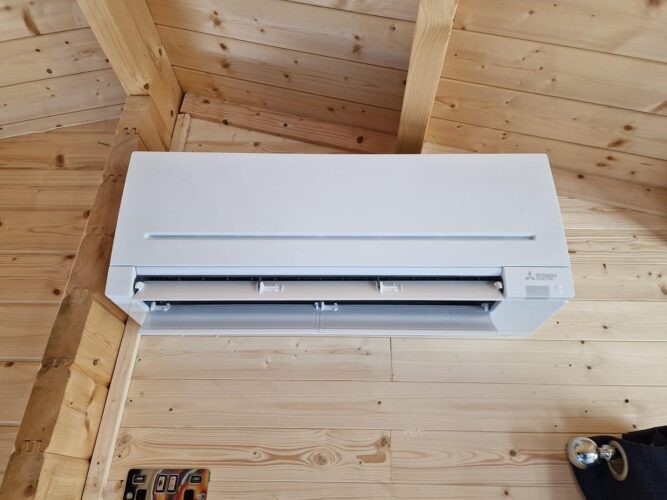
Garden room installs at a glance
- Typical unit
- 2.0–3.5 kW
- Price from
- £2,300 supplied & fitted
- Outdoor unit
- Beside or behind the building
- Heating too
- Yes, same unit
- Survey
- Free
What size unit does a garden room need?
Size depends on floor area, glazing and insulation. A well-insulated garden office needs less than a glass-fronted studio of the same size, and a home gym needs more because people exercising give off a lot of heat.
| Garden room | Floor area | Unit size | Fujitsu, from | Mitsubishi Electric AY, from | Daikin Perfera, from |
|---|---|---|---|---|---|
| Small room | 5–10 m² | 2.0 kW | £2,300 | £2,450 | £2,500 |
| Standard room | 11–18 m² | 2.5 kW | £2,400 | £2,550 | £2,600 |
| Large room | 19–29 m² | 3.5 kW | £2,500 | £2,650 | £2,700 |
Prices are for one room, fully supplied and fitted, from our instant price calculator. Home installations carry 0% VAT. Your final price is fixed after the survey. Whole-house examples are in our London price guide.
These are our standard options. The prices above are for the systems we fit most often: Fujitsu, Mitsubishi Electric AY, Daikin Perfera and concealed ducted. Other brands and models are available if you would prefer, such as other Daikin and Mitsubishi Electric ranges, Toshiba, LG, Samsung or Panasonic. Just ask and we will price it for you.
What to check first
- A suitable electrical supply to the building
- A solid wall for the indoor unit
- Space beside or behind it for the outdoor unit
- How close it is to the boundary and neighbours’ windows
- Whether the room is insulated or just a summer house
- Any planning conditions on the building
If the building doesn’t have a suitable supply from the house, that needs sorting before the install, and we will tell you what is needed.

Garden offices, studios and gyms
Most commonGarden offices
Usually a 2.0–2.5 kW wall unit. It keeps the room comfortable for long working days and heats it on cold mornings.
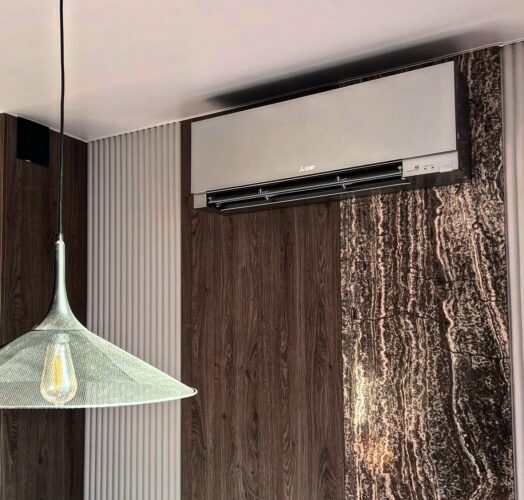 Studios
 and music rooms
Larger glass areas usually mean the next size up. For music rooms we pay extra attention to where the outdoor unit goes.
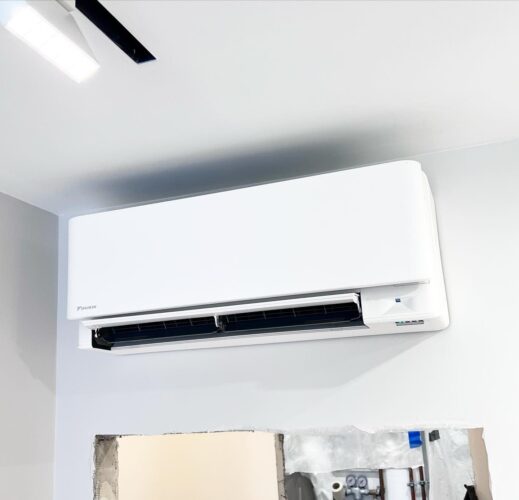 Gyms
Home gyms
People exercising give off a lot of heat, so gyms normally need more cooling than their floor area suggests.
Do you need planning permission?
The short version for houses in England: an air conditioner that heats as well as cools (an air-to-air heat pump) can be permitted development, so no planning application, as long as it meets the national conditions. It must not be used only for cooling. On a terraced or semi-detached house only the first outdoor unit is covered. It can’t go on a pitched roof, or above ground-floor level on a wall that faces the road. In a conservation area it can’t go on a wall or roof facing the road at all, and listed buildings always need consent.
Flats are different: you will normally need written consent from your freeholder or managing agent under your lease. Councils can also remove permitted development rights with an Article 4 direction.
Source: Planning Portal, air source heat pumps. If your home is listed, in a conservation area or covered by an Article 4 direction, check with your council before work starts.
The heat pump permitted development rules cover units on buildings within the garden of a house, not just the house itself, under the same conditions.
Garden room questions
Where does the outdoor unit go?
Usually on the ground beside or behind the building on a stand or anti-vibration feet. On a timber building we avoid hanging it on the wall unless the structure is built for it.
Can the garden room run off the house supply?
Often, if there is already a suitable armoured cable to the building. If not, it needs adding before the air conditioning goes in.
Is it worth it for a summer house?
If the room is uninsulated, an air conditioner will help but has to work hard. It is most worthwhile in an insulated garden room you use all year.
Get a garden room price in two minutes
Tell us the room size and we will show you four options with fixed starting prices.
Other rooms we cool
- Bedrooms
- Loft rooms
- Living rooms
- Home offices
- Garden rooms
- Conservatories
- Flats
- Several rooms
- Offices & shops
See the areas we cover across London, Surrey and Hertfordshire